Reference that is in tension with my project:
Dieter Rams’ 10 Principles of Good Design & the book Dieter Rams: 10 Principles of Good Design (Jong C. d., Klemp K., Mattie E. and Rams D. (2021). Ten principles for good design. Munich: Prestel.)
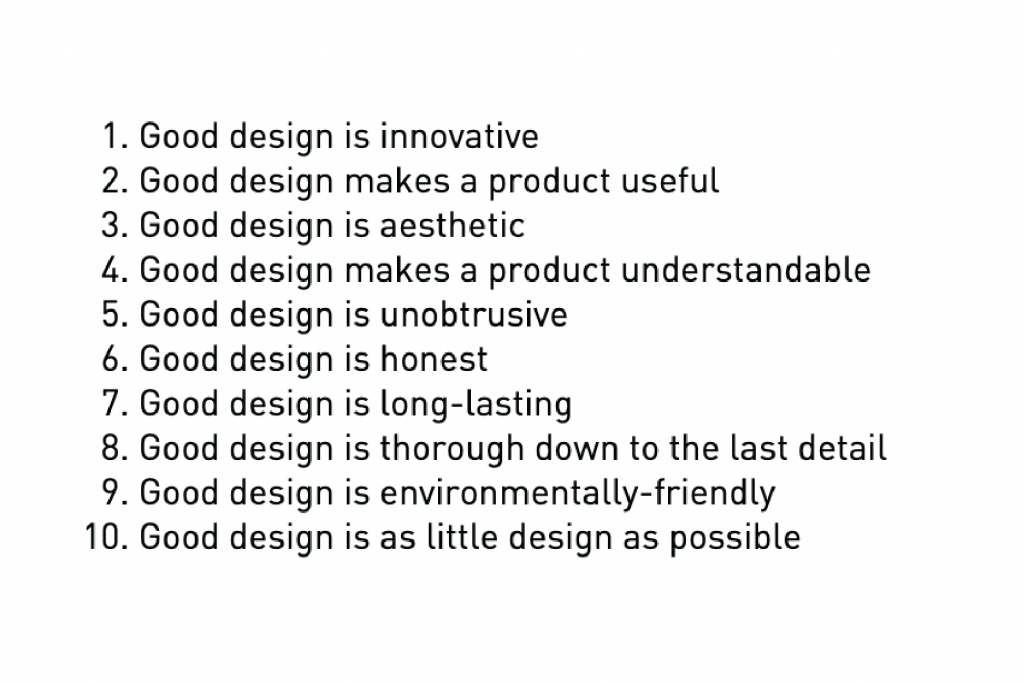
Draft 1:
Feedback & Reflection:
- “reduction” : is simplicity / purity always achieved through reduction (by taking things away)? or can it also be about not adding? compare additive vs subtractive process
- What enables something to adapt? How does one design for adaptability?
- it could be helpful to give examples of ‘good design’ as desfined by Rams, alongside an example of a design with more ‘friction’, and describe how they differ aesthetically and functionally
- re-order the analysis into two categories: Aesthetic & Functional?
- Aesthetic: Order vs Randomness – what are the values/purpose of each?
- Functional: does my practice concern itself with function? What kinds of function?
- demonstrate an understanding of the principles of modernism – universality in design language/aesthetics – and how this is situated in broader/other design histories
Draft 2:
Reflection:
- not really about “randomness” anymore
- is it more about specific (forms, experiences) <–> General/abstract ?